BIOGRAPHY
Jim Melchert was a revered figure in the San Francisco Bay Area, as much for his personal generosity as for his profound impact on the arts. He was a first-generation conceptual artist and an essential part of a group that created a seismic shift in the ceramic field, one that elevated ceramics from a utilitarian craft to a sculptural art form.
James Frederick Melchert was born on Dec. 2, 1930, in New Bremen, Ohio. The third and youngest son of Rev. John Carl Melchert and Hulda Egli, he graduated with a degree in art history from Princeton University in 1952. Declaring himself a conscientious objector during the Korean War, he was given alternative service teaching English in Sendai, Japan, where he lived for four years. There, he met and married Mary Ann Hostetler. They had two sons before moving back to the United States in 1956. He taught at San Francisco Art Institute from 1961 to 1965 where he and Ron Nagle founded the ceramics program.
“At the San Francisco Art Institute he immersed himself in the Bay Area art scene, befriending artists such as Carlos Villa, with whom he once shared a studio, Manuel Neri, Nathan Oliveira and Joan Brown. Through Peter Voulkos, he also made connections in the L.A. ceramics world, including John Mason, Henry Takemoto and Michael Frimkess. Melchert’s early ceramic work combined qualities of Abstract Expressionism with the eclectic, figurative impulses of the emerging California Funk movement. His sculptures from this time look like whimsical industrial castoffs or colorful yet mangled theatrical masks, toeing the line between objects and bodies, abstraction and figuration.” – Los Angeles Times
From 1977 until 1981, Melchert served as the director of Visual Arts Program for the National Endowment for the Arts (NEA). Melchert left the Bay Area for the National Endowment for the Arts in Washington, D.C. in 1976, where he strengthened and diversified the NEA grant programs supporting artists and nonprofit art spaces. Melchert quickly began to change how funds were implemented. He instituted the “Peer Review” process, a new concept for evaluation, which still stands today across many disciplines. He was insistent on ethnic and gender diversity on those panels. He increased female panelists from 10% in the previous years to over 40% during his term. “We wanted artists and curators who would be very open to ideas different from their own. At the same time, we wanted to have panelists who knew what African American artists or Spanish-speaking artists were up to because their work wasn’t in that many galleries at the time. So, we wanted individuals who represented that community. I wanted to contribute to the advancement of individuals from those communities”.
“Melchert’s work began to move in a more conceptual direction, influenced by concrete poetry and the work of composer John Cage. In 1972, he organized a performance called “Changes” at Hetty Heisman Studio in Amsterdam, in which he and a group of Dutch artists each submerged their heads in a bucket of wet clay slip and sat on a bench as the slip dried and cracked, becoming a kind of living sculpture.” – Los Angeles Times
Melchert returned to Berkeley from Washington D.C. in ‘81, just before the start of the fall semester at UC Berkeley. He resumed his role as chair of the art practice department for several years before being unanimously chosen to be the new director of the American Academy in Rome. He served as director of the American Academy in Rome until 1988. During Melchert’s tenure many well-known artists, drawn from his vast network, passed through the Academy’s gates as Residents, including Ana Mendieta, Alex Katz, Vito Acconci, Bruce Nauman and Judy Pfaff. At Melchert’s insistence, an art studio came with his job as Director. The building had a high ceiling with a clerestory that let natural light stream down. Isamu Noguchi had once used this studio.
From 1965 to 1992 University of California, Berkeley. Melchert leaves behind several important legacies and many former students and mentees, including artists working across disciplines as varied as ceramics, poetry, music, and architecture. Berkeley’s Art Practice department was forever changed by the conceptual thinking practices Melchert introduced through his courses, particularly Introduction to Visual Thinking, but also by his expansive network of colleagues and admirers. Theresa Hak Kyung Cha was one of his many notable students at UC Berkeley.
Melchert’s work has been exhibited at and in the collections of pretigious Museums around the world including the Whitney Museum and the Museum of Art, the Victoria and Albert Museum in London, the Museums of Contemporary Art in Houston, and Los Angeles; at the Museums of Modern Art in San Francisco, Tokyo, and Kyoto; The Los Angeles County Museum of Art; and Documenta 5 in Kassel, Germany.
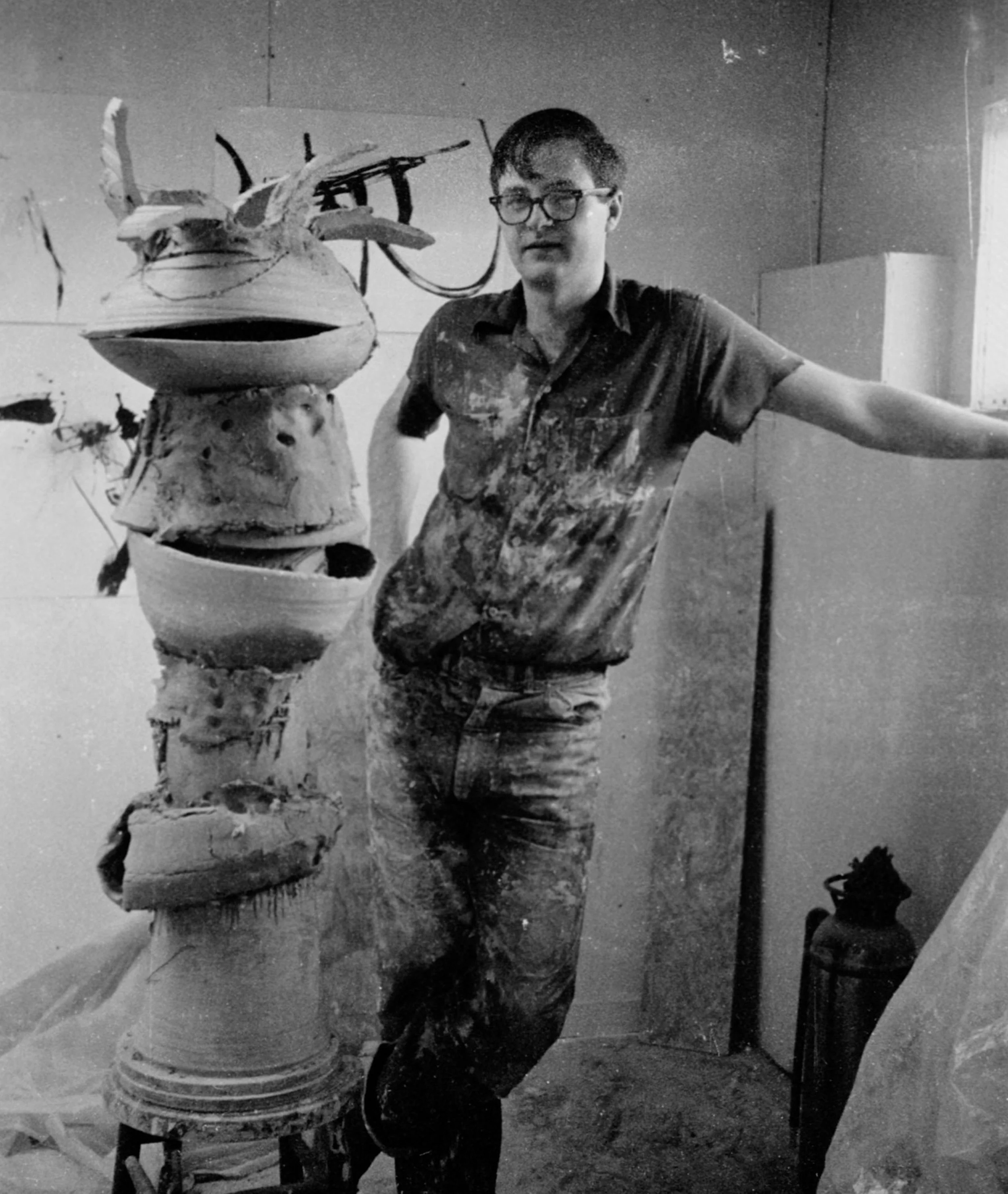
Jim Melchert in the Pot Shop, February 1960